

 Borders Ref Help Toolkit
Who to refer and who not refer:
Please refer to diagram above.
How to refer:
Via SCI gateway as indicated in diagram above

A “normal” menstrual cycle is defined based on 4 parameters (frequency, regularity, duration, or volume) summarised the table below:
| Parameter Normal Limits | (5th to 95th centile) |
| Frequency of menses (days) | 24 to 38 days |
| Regularity (Cycle length) | ≤7 to 9 days |
| Duration (days of bleeding in a single menstrual period) | ≤8 days |
| Volume (monthly blood loss) | Clinical definition is subjective and defined as a volume of menstrual blood loss that does not interfere with a woman’s physical, social, emotional, and/or quality of life |
This is the overarching term used to describe any symptomatic variation from normal menstruation and also includes intermenstrual bleeding. The Table below summarises the recommended terminology for women with AUB.
| Parameters | Terminology | Outwith 5th to 95th centile |
| Frequency of menses (days) | Absent | Amenorrhoea – Primary or Secondary |
| Infrequent | >38 days | |
| Frequent | <24 days | |
| Regularity (Cycle length) | Irregular | Variation >10 days – Cycle length is the number of days from the first day of one menstrual cycle to the first day of the next |
| Duration (days of bleeding in a single menstrual period) | Prolonged | >8 days |
| Volume (monthly blood loss) | Heavy or light | Subjectively defined |
| Spontaneous bleeds occurring in between periods | Intermenstrual bleeding (IMB) |
Cyclic (early, mid, late cycle) or random, Midcycle IMB may represent a nadir in estradiol levels (ovulation) and is physiological (9% of women) |
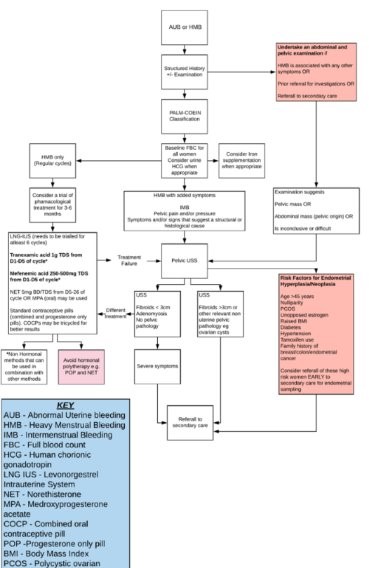
Click for full-size image
Please refer to diagram above.
Via SCI gateway as indicated in diagram above
Please refer to diagram above for primary care advice.
Obsandgynae.mailbox@borders.scot.nhs.uk